
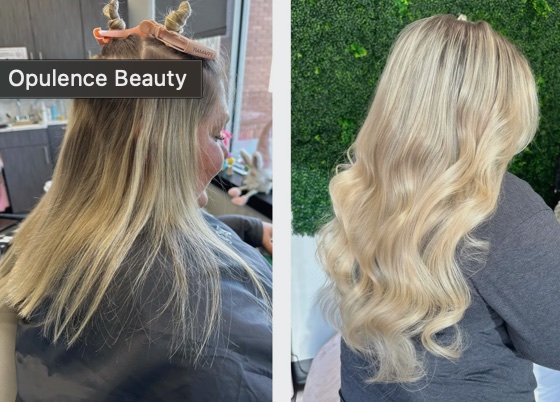
Yes, fine and thinning hair can wear extensions — but the method has to be light, the placement has to avoid tension, and the amount of hair has to be honest about what your own hair can carry. Lighter hand-tied and bead-and-thread systems generally suit fine hair better than heavy wefts or large tape panels. Every install at Opulence Beauty starts with a $30 consultation for exactly this reason.
Key Takeaways
- Fine hair is not a disqualifier; the wrong weight and wrong placement are.
- Lighter hand-tied rows and small bead-and-thread systems distribute weight better across fine hair than heavy single wefts.
- Tension at the attachment point, not the extension itself, is what causes traction damage.
- Move-ups every 6 to 10 weeks are non-negotiable for fine hair — overgrown attachments are where damage starts.
- Opulence Beauty installs seven methods, so the system is matched to your hair rather than to whatever the studio stocks.
"My hair is too fine for extensions" is one of the most common things clients say at consultation — usually after a bad experience somewhere else, or after reading a horror story online. Fine hair is not the problem. Weight, placement and maintenance are, and all three are choices your stylist makes.
Can You Wear Extensions With Fine or Thinning Hair?
In most cases, yes. Fine hair simply has a lower weight budget. Each attachment point can carry a limited amount of added hair before it starts pulling, so a good install for fine hair uses less hair, spread across more points, placed where there is enough density to hide and support it.
What genuinely rules extensions out is active shedding from a medical cause, visible scalp inflammation, or hair that is mid-recovery from chemical damage. Those need to settle first. That assessment is the entire purpose of a consultation, and it is why no install here is booked sight-unseen.
Methods Compared for Fine Hair
Opulence Beauty works across seven methods rather than one, which matters more for fine hair than for any other hair type — the whole point is having a lighter option available.
| Method | Fine hair fit | Why |
|---|---|---|
| Hand-tied rows | Excellent, when kept light | Thin, flat rows sit close to the head and spread weight across a full beaded row |
| Bead-and-thread systems | Excellent | Weight divided across many small attachment points; easy to adjust density |
| Tape-in | Good, in small panels | Very flat and undetectable; needs conservative panel size and careful placement |
| Machine weft | Situational | Thicker seam adds weight; better suited to medium and dense hair |
| Heavy single wefts | Usually not advised | Concentrates too much weight on too few points for a fine hair line |
The full menu, including what each method costs, is on the hair extensions page, and every method's pricing and longevity is broken down in our cost guide.
"Fine hair doesn't need less experience, it needs more. Anyone can make thick hair look good with extensions. Making fine hair look natural and stay healthy is the actual skill."
— Brandi, Master Hair Extension Artist · Opulence BeautyThe Three Things That Decide Whether Fine Hair Stays Healthy
Method choice gets most of the attention online, but three execution details matter more.
- Total weight. An honest install adds fullness your hair can carry, not the length in the inspiration photo. Chasing an extra four inches on fine hair is the most common way installs go wrong.
- Placement. Attachments have to sit where you have density — away from the hairline, the temples and the nape, which are the thinnest and most tension-prone areas on almost everyone.
- Tension. A row should feel secure but not tight. If you can feel your install when you raise your eyebrows or lie down, it is too tight, and that needs to be said out loud in the chair, not endured.
Warning Signs Your Install Is Too Heavy
Whether your extensions came from us or from somewhere else, these are worth acting on quickly:
- Persistent tenderness or headache in the first few days, beyond a mild first-night awareness.
- Short broken hairs at the attachment points, or beads that slide freely down the hair.
- Visible thinning right at the row line as the install grows out.
- Matting at the base that will not comb out with a loop brush.
None of these are reasons to give up on extensions. They are reasons to reduce weight, reposition, and shorten the maintenance interval.
Maintenance Matters More on Fine Hair
Move-ups every 6 to 10 weeks are the standard, and fine hair sits at the shorter end of that window. As the attachment grows away from the scalp, the leverage on each strand increases and shed hair collects at the base. On fine hair, that happens sooner and shows sooner.
Between visits: brush from the ends up with a loop brush, use sulfate-free products, keep conditioner off the attachment points, dry the rows properly rather than sleeping damp, and braid loosely at night. The same protective habits we cover in our seasonal care guide apply year-round.
What It Costs
Every hair extension service begins with a $30 consultation, where the method, the amount of hair, the color match and an exact quote are settled before anything is ordered. Natural installs run $800 to $1,600 and Full Glam installs $2,000 to $3,200, hair included. Fine hair installs frequently land at the lower end for the simple reason that they use less hair. A 4% fee applies to card payments for extension services.
Fine Hair and Thinning Hair Are Not the Same Problem
These two words get used interchangeably, and they call for different answers. Fine hair describes strand diameter: you may have plenty of hair, but each strand is slender, so the hair reads soft and lies flat. Thin or low-density hair describes how many strands you have, regardless of how thick each one is. Plenty of people have both, and a few have fine strands at high density, which is one of the easiest hair types to work with.
The distinction matters because it changes the plan. Fine strands limit how much weight each attachment can carry, so the answer is lighter hair spread wider. Low density limits where attachments can hide, so the answer is careful placement and a more conservative row count. Diffuse shedding is a third situation entirely, and it belongs with a physician before it belongs in an extension chair.
What Happens at a Consultation
The $30 consultation takes about fifteen to twenty minutes and covers five things: an assessment of your density and strand strength, a look at the hairline, temples and nape for existing tension or thinning, a conversation about how you actually live — gym, ponytails, lake days, how often you heat style — a color match against your current tone and any planned color work, and a specific method recommendation with an exact written quote.
You will also be told what your hair will not do. If the length in your reference photo requires more weight than your hair can carry, you will hear that in the consultation rather than discover it three months into an install. Nothing is ordered and no deposit is taken until you decide to move forward.
From Consultation to Install: The Timeline
- Consultation. Method, amount and color settled; hair ordered to match.
- One to two weeks later. Hair arrives and the install is scheduled. Fine-hair installs typically run two to four hours depending on method and row count.
- Two weeks after install. A quick check-in, especially on a first install, to confirm nothing is sitting tight and that you are comfortable with the home routine.
- Six to eight weeks. First move-up. Fine hair sits at the shorter end of the general window.
If color is part of the plan, it is usually best done in the same visit or immediately before the install, so your own hair and the extension hair are matched under the same light. Details on the color side are on the color and blonding page.
Your Top Questions, Answered Directly
Can I get hair extensions if my hair is fine or thin?
Usually yes. Fine hair needs a lighter method, less total hair, and placement away from thin or tension-prone areas like the hairline, temples and nape. Active medical shedding, scalp inflammation, or hair recovering from chemical damage should be addressed first, which is what the consultation determines.
What is the best hair extension method for fine hair?
Lightweight hand-tied rows and small bead-and-thread systems generally suit fine hair best, because the weight is divided across many small attachment points. Small tape-in panels also work well since they lie very flat. Heavy single wefts are usually not advised on fine hair.
Will hair extensions make my thin hair worse?
Not when the weight is appropriate, the placement avoids tension, and move-ups happen every 6 to 10 weeks. Damage on fine hair traces almost entirely to installs that are too heavy, rows placed under tension, or maintenance stretched too long.
How much hair can fine hair actually hold?
It varies with your density and strand strength, which is why it is measured in person. As a rule, fine hair does better prioritizing fullness over dramatic length; adding several inches of length usually requires more weight than a fine hair line can comfortably carry.
How often do extensions need moving up on fine hair?
Every 6 to 8 weeks is typical for fine hair, at the shorter end of the general 6 to 10 week window. As the attachment grows out, leverage on each strand increases and shed hair collects at the base, and both show sooner on fine hair.
How much do hair extensions cost near Huntersville and Charlotte, NC?
At Opulence Beauty in Cornelius, Natural installs run $800 to $1,600 and Full Glam installs $2,000 to $3,200, hair included, after a $30 consultation that provides an exact quote. Fine hair installs often fall at the lower end because they use less hair.
Can extensions cover thinning at the crown or part?
Sometimes, with realistic expectations. Extensions add density below the attachment point, so they blend and thicken mid-length and ends well but cannot create coverage at the part or crown itself. That is assessed honestly at consultation rather than promised in advance.
Consultations Near Huntersville, Cornelius & Lake Norman
Opulence Beauty is at 17111 Kenton Drive #202B in Cornelius, NC — ten minutes from Huntersville, eight from Davidson, fifteen from Mooresville — and installs are by appointment only. If you have been told elsewhere that your hair is too fine for extensions, a $30 consultation will give you a straight answer either way, along with a written quote if the answer is yes. Call or text (828) 291-8119, or see the FAQ page for more.
About Opulence Beauty
Opulence Beauty is a private, by-appointment luxury lash, hair extension and blonding studio at 17111 Kenton Drive #202B in Cornelius, NC — roughly ten minutes from Huntersville, eight from Davidson, and under half an hour from uptown Charlotte. Every product used is vegan, all-natural and non-toxic, and the studio is a Green Circle Salons partner.
Book Your Appointment →
Brandi
Founder of Opulence Beauty in Cornelius, NC. 16 years of professional lash, hair extension and blonding artistry serving Huntersville, Lake Norman and the greater Charlotte area. All-natural, vegan, sustainable beauty is the only kind practiced here.